
Can ProDentim Whiten Teeth and Stop Bad Breath?
Investigating its actual impact on halitosis and tooth brightness.
Two of the biggest reasons people search for ProDentim benefits are the promises that it can freshen breath and brighten teeth. These are also two of the most skeptic-worthy claims in the supplement space — bad breath and tooth whitening are both often used as marketing hooks. So what does the evidence actually show? This article breaks down the ProDentim benefits for halitosis and tooth brightness, separates the realistic from the overstated, and gives you the information you need to decide if it’s worth trying. If you want to get started, check the current ProDentim offer here — or read on for the full breakdown.
Table of Contents
- What ProDentim Claims to Do for Breath and Teeth
- ProDentim Benefits for Bad Breath: What the Evidence Shows
- The Strains Behind the Breath Claims
- ProDentim Benefits for Teeth Whitening: The Malic Acid Claim
- What Independent Sources Say About the Whitening Evidence
- Other ProDentim Benefits Worth Knowing
- Realistic Expectations: What This Supplement Can and Can’t Do
- Ready to Try It?
- FAQ
What ProDentim Claims to Do for Breath and Teeth
Before evaluating the ProDentim benefits specifically tied to breath and whitening, it helps to know exactly what the manufacturer says.
On halitosis, the brand markets the supplement’s probiotic strains as working to rebalance the oral microbiome — reducing the population of anaerobic bacteria that produce volatile sulfur compounds (VSCs), which are the primary biological cause of chronic bad breath. This is not an unreasonable mechanism; it’s how oral probiotic research generally approaches the halitosis problem.
On whitening, the manufacturer points to malic acid — a naturally occurring compound sourced from strawberries — as the active ingredient for tooth brightness. According to the official ProDentim website, malic acid is included to help maintain tooth whiteness and prevent staining, described as a gentle, non-abrasive alternative to harsh bleaching agents.
These are the claims. Whether the evidence supports the ProDentim benefits being marketed is a different question — and the answer varies depending on which benefit you’re looking at.
ProDentim Benefits for Bad Breath: What the Evidence Shows
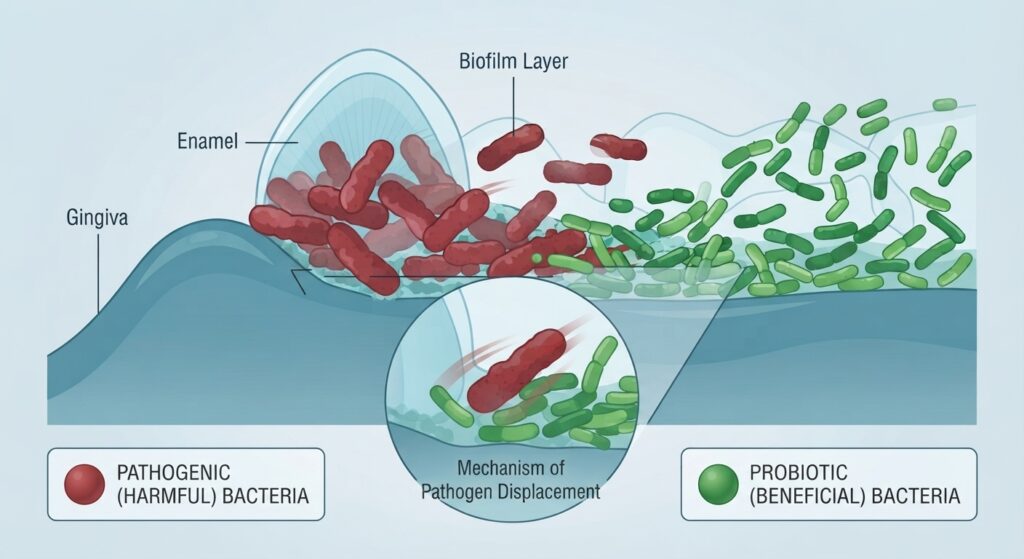
Of the two big ProDentim benefits being examined here, the case for breath improvement is significantly stronger than the case for whitening.
Bad breath that persists despite brushing and flossing has a microbiological cause: anaerobic bacteria — typically living on the back of the tongue and between gum tissue — break down proteins and produce sulfur gases. No toothpaste or mouthwash can permanently resolve this, because those products reduce bacterial load temporarily but don’t change the underlying population. Probiotics aim to address it differently — by introducing competing beneficial bacteria that can displace the odor-producing strains over time.
Published research on oral probiotics and halitosis does exist. L. reuteri, which is one of ProDentim’s three core probiotic strains, has been studied in connection with reducing gingival inflammation and improving the oral microbial environment. Lactobacillus paracasei, another strain in the formula, has research support for supporting the balance of oral bacteria. B. Lactis BL-04 contributes to overall bacterial balance.
However, one honest note is warranted: the most specifically studied strains for chronic bad breath are Streptococcus salivarius K12 and M18, which appear in products like BURST Oral Probiotics. These strains have the most direct halitosis-specific research. The ProDentim benefits for breath are real but come from a general microbiome-support approach rather than a targeted halitosis formula.
Real-world user feedback consistently identifies fresher breath as the most commonly reported ProDentim benefit among satisfied users, typically noticed after two to four weeks of consistent daily use. This aligns with how probiotic mechanisms work — gradual colonization rather than instant results.
The Strains Behind the Breath Claims

To understand the ProDentim benefits related to breath, it helps to look at each relevant ingredient:
- Lactobacillus Reuteri — has been studied in connection with reducing gingival index scores and bacterial counts in the oral cavity. Some research links its competitive exclusion effect to reduced VSC production.
- Lactobacillus Paracasei — linked to supporting sinus health and the nasal-oral environment, which can contribute to post-nasal drip-related bad breath.
- Peppermint and Spearmint — beyond flavoring, peppermint oil has shown some inhibitory effects on oral pathogens in laboratory studies. In the context of a daily chewable, the primary practical contribution is immediate freshness.
- Inulin (prebiotic) — feeds the beneficial bacteria introduced by the probiotic strains, potentially helping them colonize more effectively.
Together, these contribute to the ProDentim benefits around breath — but they represent a general-support approach, not a targeted halitosis treatment.
ProDentim Benefits for Teeth Whitening: The Malic Acid Claim
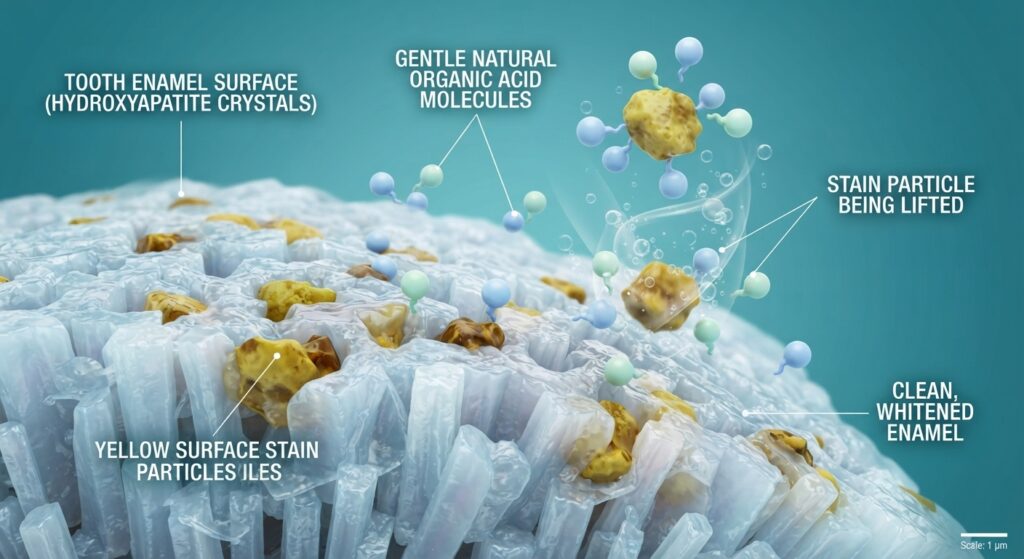
This is where the evaluation of ProDentim benefits requires more caution. The manufacturer is clear that the whitening mechanism is malic acid, described as a non-abrasive, naturally derived compound from strawberries.
Malic acid is a real compound with real properties. It is a mild organic acid found naturally in many fruits and is generally recognized as safe in food amounts. The logic behind including it in an oral supplement for tooth brightness is that mild acids can help remove surface staining by slightly softening the pellicle — the thin film on tooth surfaces where staining compounds adhere.
Here is where the honest evaluation of ProDentim benefits on whitening must be direct: the evidence for malic acid producing meaningful whitening at the doses present in a single daily chewable tablet is limited. Unlike the probiotic strains where there is a body of relevant oral health research, the clinical evidence specifically supporting malic acid as a whitening agent in supplement form is thin.
What Independent Sources Say About the Whitening Evidence
Independent dental-focused analysis outside of affiliate and marketing pages is consistent on this point. The Tooth Labs, a dental ingredient review site, notes that the ProDentim benefits whitening claim “rests on very thin evidence for supplemental doses.” They also point out that the ADA has cautioned about acidic compounds applied repeatedly to tooth surfaces and enamel erosion risk — though the trace amounts in a single daily chewable are unlikely to cause harm for most people.
Tricalcium phosphate, another ingredient in ProDentim, is more widely recognized in dentistry. Calcium phosphate compounds are used in some clinical dental products to support enamel remineralization. Its inclusion in a chewable that contacts teeth directly has reasonable logic, though the undisclosed dose makes the exact contribution hard to evaluate.
The practical summary on ProDentim benefits for whitening: if you’re hoping for a noticeably whiter smile, set those expectations carefully. This formula may contribute to surface stain prevention at the margins, but it’s not a whitening treatment in the way that hydrogen peroxide products or professional whitening are. Users who report whiter teeth are more likely observing reduced surface staining from improved microbiome balance than any bleaching effect from malic acid directly.
Other ProDentim Benefits Worth Knowing
Beyond teeth whitening and bad breath, the broader ProDentim benefits case is actually on more solid ground in several areas:
Gum health support — L. reuteri has been researched in connection with reductions in gingival inflammation. Users reporting less gum bleeding and more comfortable flossing over 6-8 weeks are describing an outcome with real biological plausibility. This is the most evidence-consistent of the ProDentim benefits.
Oral microbiome balance — B. Lactis BL-04 contributes to the broader population balance of bacteria in the mouth. A healthier bacterial ecosystem is associated with lower plaque accumulation and reduced likelihood of cavity-causing bacteria dominating.
Sinus and upper respiratory support — L. Paracasei is noted in the manufacturer’s marketing for sinus-related benefits. Some research does link oral microbiome health to upper respiratory health, though this is a secondary benefit rather than a primary one.
These ProDentim benefits — centered on gum health and microbiome support — are more evidence-consistent than the whitening claim and roughly comparable in credibility to the breath claim.
Realistic Expectations: What This Supplement Can and Can’t Do
Reviewing the ProDentim benefits honestly means being clear about what to expect and what not to:
Realistic ProDentim benefits to expect with consistent use over 6-12 weeks:
- Gradual improvement in morning breath freshness
- Reduced gum irritation and more comfortable flossing
- A generally cleaner-feeling mouth during the day
- Possible reduction in surface staining (not meaningful whitening)
What ProDentim benefits do not include:
- A substitute for brushing and flossing — it’s an add-on, not a replacement
- Verified teeth whitening comparable to whitening strips or professional treatment
- A cure for chronic bad breath without addressing diet and hygiene habits
- A treatment for gum disease, cavities, or any diagnosable dental condition
ProDentim is a dietary supplement — not FDA-evaluated or approved for any dental health claim. For serious or persistent oral health issues, always see a dentist. The American Dental Association remains the best starting point for guidance on specific dental concerns.
Ready to Try ProDentim?

If you’re looking for a daily supplement to complement your oral hygiene routine — specifically for breath support, gum comfort, and microbiome balance — the ProDentim benefits in those areas are supported by reasonable ingredient-level evidence. Just go in with accurate expectations, buy direct to protect your guarantee, and give it a consistent trial of at least 60-90 days before judging.
👉 Visit the Official ProDentim Website & See Today’s Offer
For more detail, see our [ProDentim Price & Discounts] guide, [How to Take ProDentim] for the correct daily routine, and our [ProDentim Customer Reviews & Complaints] for real buyer feedback.
FAQ
Can ProDentim actually whiten teeth? The manufacturer includes malic acid for tooth brightness, but independent dental ingredient reviewers note the ProDentim benefits whitening claim has thin evidence at supplement doses. Surface stain prevention is more plausible than deep whitening. Don’t expect results comparable to peroxide-based whitening products.
How quickly do ProDentim benefits for bad breath appear? User feedback and probiotic research both suggest gradual results. Most people who report fresher breath notice it after two to four weeks of consistent daily use. Overnight results aren’t realistic for a microbiome-based approach.
Is ProDentim better than mouthwash for bad breath? Different mechanisms. Mouthwash kills bacteria temporarily for an immediate effect. ProDentim benefits work by gradually shifting the bacterial population — a slower process aimed at longer-term microbiome balance. Used in sequence (mouthwash before ProDentim, not after), they can complement each other.
Do the ProDentim benefits include gum health improvement? Yes — this is actually the strongest evidence area. L. reuteri, one of ProDentim’s core strains, has the most published research for gum health outcomes including reduced inflammation and improved gingival scores.
Are ProDentim benefits different for everyone? Yes. The ProDentim benefits you experience depend on your existing oral microbiome, diet, hygiene consistency, and how long you use it. Some users report significant improvements in breath and gum comfort; others notice little change. The 60-day money-back guarantee exists precisely because results vary.